For anyone trying to positively influence U.S. foreign policy, knowing the "caste" of the person you're talking to can make all the difference. It also explains the why the State Department section of your rolodex changes so insanely often. (more after the jump)
Showing posts with label information. Show all posts
Showing posts with label information. Show all posts
12 February 2010


07 January 2010
State and Energy: A Wonk's-Eye View
Ever since my Fellowships at the U.S. State Department and the Department of Energy, I've fielded calls from friends, acquaintances, and complete strangers, all looking for more information about my time there, how I got those gigs, and how those beasts actually function.
It's no wonder. The details available in places like Wikipedia on these bureaucracies are fairly sparse and abstract. (Which is surprising, since there are a few books on
on the subject
 , which I haven't read.) Where folks do talk openly about their time in such places, they might focus on juicy gossip about their co-workers, scandals, and major events, rather than on how the organizations actually operate—and how folks should use these systems to their advantage, from both within and without.
There are some pretty good reasons for much of this, as will hopefully become apparent. There are many incentives to keep information hidden, not all nefarious. Luckily, since I don't work at either place anymore, I can say (almost) whatever I please.
So, as an occasional series, I'll try to fill in some gaps. I'll start off with the State Department, as it's better-known and more fresh in my mind. If you have any questions to start off, please ask!
 |
It's no wonder. The details available in places like Wikipedia on these bureaucracies are fairly sparse and abstract. (Which is surprising, since there are a few books
on the subject, which I haven't read.) Where folks do talk openly about their time in such places, they might focus on juicy gossip about their co-workers, scandals, and major events, rather than on how the organizations actually operate—and how folks should use these systems to their advantage, from both within and without.There are some pretty good reasons for much of this, as will hopefully become apparent. There are many incentives to keep information hidden, not all nefarious. Luckily, since I don't work at either place anymore, I can say (almost) whatever I please.
So, as an occasional series, I'll try to fill in some gaps. I'll start off with the State Department, as it's better-known and more fresh in my mind. If you have any questions to start off, please ask!
08 December 2009
Yahoo Thinks You're Gay. Now, Find Out Why.
Ever wonder why you get the particular advertisements you see when using tools like Yahoo? Most of the time, the ads relate to the content you're accessing at the time, like ads for pet services when you spend all day looking at cute pictures of kittens instead of applying for jobs like you promised you would.
But even if you're not logged in at sites like Yahoo!, Google, or Facebook, those companies tend to collect quite a bit of information on you, creating their own consumer profile of you, which they use to match you up with targeted ads. Wouldn't it be great to take a look at that profile? Wouldn't you like the option to edit such a profile, or turn it off altogether?
 Thanks to increasing pressure from transparency advocates and the U.S. Federal Trade Commission, Yahoo! is taking a baby step in this direction. Yahoo! is launching a test version of it's Ad Interest Manager (AIM), which shows you a summary of the info that Yahoo! has on you. I haven't logged in at Yahoo! in a while, so without logging in, I took this screenshot of the AIM site. Now, it definitely gets some things right, like my age range, gender, OS and browser. It still thinks I'm in DC, which is odd because I'm on the other coast, now. When I log in, I see exactly the same profile, except that "Entertainment" has been added as an interest.
Note that Yahoo! appears to know who I am, even when I'm logged out! Yahoo's policy is to de-identify data after 6 months at the most, but they never delete it.
To be sure, this kind of access is only the beginning of what consumers should demand, and the AIM tool has received mixed reviews from confusing, but better than Google to half-hearted. But, it is a start.
Are there alternative search engines that will show you what data they collect?
[Google's closest analog - Dashboard]
[Edit: Grammar, and the last question.]
But even if you're not logged in at sites like Yahoo!, Google, or Facebook, those companies tend to collect quite a bit of information on you, creating their own consumer profile of you, which they use to match you up with targeted ads. Wouldn't it be great to take a look at that profile? Wouldn't you like the option to edit such a profile, or turn it off altogether?
 Thanks to increasing pressure from transparency advocates and the U.S. Federal Trade Commission, Yahoo! is taking a baby step in this direction. Yahoo! is launching a test version of it's Ad Interest Manager (AIM), which shows you a summary of the info that Yahoo! has on you. I haven't logged in at Yahoo! in a while, so without logging in, I took this screenshot of the AIM site. Now, it definitely gets some things right, like my age range, gender, OS and browser. It still thinks I'm in DC, which is odd because I'm on the other coast, now. When I log in, I see exactly the same profile, except that "Entertainment" has been added as an interest.
Note that Yahoo! appears to know who I am, even when I'm logged out! Yahoo's policy is to de-identify data after 6 months at the most, but they never delete it.
To be sure, this kind of access is only the beginning of what consumers should demand, and the AIM tool has received mixed reviews from confusing, but better than Google to half-hearted. But, it is a start.
Are there alternative search engines that will show you what data they collect?
[Google's closest analog - Dashboard]
[Edit: Grammar, and the last question.]
27 September 2009
Jefferson, Interrupted
 Thomas Jefferson's words are heavily censored in his own memorial in Washington, DC. Consider this passage from the Declaration of Independence, inscribed on the interior of the memorial:
We hold these truths to be self-evident that all men are created equal, that they are endowed by their Creator with certain inalienable rights, among these are life, liberty, and the pursuit of happiness, that to secure these rights governments are instituted among men. We...solemnly publish and declare, that these colonies are and of right ought to be free and independent states...And for the support of this declaration, with a firm reliance on the protection of divine providence, we mutually pledge our lives, our fortunes, and our sacred honour.
 Despite the fact that the passage in yellow was never written by Jefferson, this looks fair enough, until you take a look at the actual text of the Declaration:
We hold these truths to be self-evident, that all men are created equal, that they are endowed by their Creator with certain unalienable Rights, that among these are Life, Liberty and the pursuit of Happiness. That to secure these rights, Governments are instituted among Men, deriving their just powers from the consent of the governed, That whenever any Form of Government becomes destructive of these ends, it is the Right of the People to alter or to abolish it, and to institute new Government, laying its foundation on such principles and organizing its powers in such form, as to them shall seem most likely to effect their Safety and Happiness.The passage in green, which Jefferson thought was the whole point of the Declaration, was dropped. Some editing to conserve space is appropriate, but this gutting of his message is ridiculous. Of course, I'm not the first to notice this censorship. Let's hope I won't be the last.
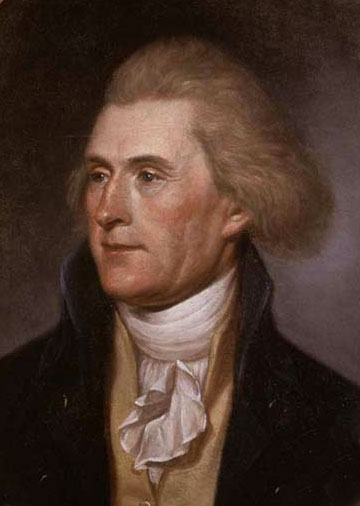
In light of Mr. Jefferson's prominent role as the supplier of our new lead quotation here, let's raise a glass to this Founding Father, censored in his own memory.
Update: Since folks have asked, my point is that this type of editing is dangerously Orwellian. Even our national monuments may be lying to us. (The memorial was constructed just a few years before Orwell completed 1984.)
(Thanks to Tony the Misfit for the gorgeous image of the Memorial.)
25 August 2008
Censorship vs Terrorism? Animals vs Science?
The cars of two UCSC scientists and their families were firebombed earlier this month, reportedly by an animal-rights group. In response to these detestable attacks, some scientists have proposed internet censorship as a method of preventing this violent harassment. More than simply ineffective, this measure would be counterproductive. There is another, more transparent way that we should pursue immediately.
To be clear, no group has claimed responsibility for the attacks, and the animal-rights community is divided over the issue. The Humane Society has gone so far as to offer a reward for information about the perpetrators of the incident.
In their editorial in Science Magazine, M. R. C. Greenwood, Gordon Ringold, and Doug Kellogg (GRK) correctly characterize the situation while lamenting the lack of public outcry:
But the proposed legislation, promoting secrecy as a solution, is where GRK really stumble:
Here's what we should do:
To be clear, no group has claimed responsibility for the attacks, and the animal-rights community is divided over the issue. The Humane Society has gone so far as to offer a reward for information about the perpetrators of the incident.
In their editorial in Science Magazine, M. R. C. Greenwood, Gordon Ringold, and Doug Kellogg (GRK) correctly characterize the situation while lamenting the lack of public outcry:
These are criminal acts, being investigated as an attempted homicide by local, state, and federal authorities. It is of serious concern that these acts of terrorism and their associated incendiary statements were not immediately condemned by our political leaders. There have been no high-profile or unified statements about the incidents, and days afterward, California's governor had still declined to comment.GRK further identify the need to address underlying issues in this conflict:
Those responsible must be prosecuted to the full extent of the law. Those who oppose animal research, even when conducted under strict federal and state laws, are free to express those beliefs. They are also free to reject the medicines--the fruits of animal research--that now allow us to treat disease and lead healthier lives. But they are not free to conduct a terror campaign.Though, most animal-rights activists would probably counter that they don't have an alternative; that is, they don't have the ability to reject products that have resulted from animal-testing because there's no rigorous tracking and labeling in place to identify viable alternatives. (Instead, the Center for Consumer Freedom, an industry-sponsored organization, fights all efforts to make products transparent, including nutritional labeling.)
But the proposed legislation, promoting secrecy as a solution, is where GRK really stumble:
State laws that reinforce these protections need to be enacted. A proposed bill in the California Legislature (AB2296), which would extend protection to "animal enterprise workers" similar to that provided for politicians and reproductive health workers, has been much weakened from its original intent. In its original form, it would have prevented the posting of personal information on Web sites with the intent to incite acts of violence or threaten researchers and their families.This approach of locking down information to prevent violent harassment is wrongheaded and counterproductive. Data leaks do happen. If these lists are going to exist anyway, we are much better off having them in the open. That way, at least we know who's being targeted.
Here's what we should do:
- As a society, we should prosecute these terrorists as criminals, and treat these actions as what they are, organized crime. That means bringing sophisticated financial tracking systems to bear, and applying relevant statutes like RICO to break down the support network for the groups that exist now. Financial transparency of all organizations is a way to prevent such groups from forming in the future.
- As a scientific community, we should isolate these extremists by working closely with animal rights groups like the Humane Society and individuals like Stephen Kaufman of the Christian Vegetarian Association and Eric Markus of Vegan.com that have denounced violence as a means of progress. Along with pharmaceutical and cosmetic manufacturers, we should create clear tracking and labeling protocols to give citizens real information on how much and what kind of testing goes into each product on the market. This market transparency allows us all to see the real benefits of animal testing research, as well as the opportunity to reject those benefits.
- Above all, we should not lean on censorship and secrecy for protection against violent harassment! Secrecy is a short-term solution at best, and is inherently unstable. Instead, as individual scientists, we should humanize ourselves to the animal rights community by engaging vigorously with those non-violent groups, to show them, first-hand, the science being done and the results generated.
Subscribe to:
Posts (Atom)

A More Transparent Union by Kohl S. Gill is licensed under a Creative Commons Attribution-Noncommercial-Share Alike 3.0 United States License.
Based on a work at kohlgill.blogspot.com.

 Posts
Posts


