For anyone trying to positively influence U.S. foreign policy, knowing the "caste" of the person you're talking to can make all the difference. It also explains the why the State Department section of your rolodex changes so insanely often. (more after the jump)
12 February 2010


08 February 2010
Good News: It was a great year for transparency (video)
I think it's important to remember how far we've come in the past year. The Sunlight Foundation does a great job at pushing transparency reforms on the national level, and assisting with local groups' efforts. Here's a neat, short video listing last year's accomplishments.
05 February 2010
Grade Inflation Means the Terrorists Have Already Won. Performance Evaluations Matter.

04 February 2010
See Jerry Run. See Jerry Win. See Jerry Govern. See Jerry Hide His Records. See Jerry Run Again.
 California is electing a new governor, this year. Jerry Brown used to be governor of California. The records of California governors are sealed for 50 years. Jerry Brown helped pass and uphold that law. Jerry Brown is running for governor, again, 25 years later.
Now, we can't get access to records of what Jerry Brown did the last time he was governor, without his written permission.
To put this in perspective, U.S. Presidents can seal parts of their records for at most 12 years after they leave office.
If Brown wins the Democratic nomination, I will likely vote for him and campaign for him, unless by some miracle we adopt instant-runoff voting.
See my head explode.
02 February 2010
Public records, you say? (delete) What public records?
San José officials have taken a definite step forward by opening up their personal phones and email accounts to scrutiny. But fear not, my lobbyist friends! They left themselves a tiny loophole just big enough to slip a delete button through.
 San José's City Council has moved a step toward adopting regulations that require the mayor, the council members, and their staffs to "make messages about public matters that council members send or receive on such personal devices subject to disclosure, just like other official records." This is a real advance for local government, and local public officials elsewhere may be feeling a bit nervous. Personally, I would like to see regulations like this apply to all government officials.
[Edited for clarity.]
San José's City Council has moved a step toward adopting regulations that require the mayor, the council members, and their staffs to "make messages about public matters that council members send or receive on such personal devices subject to disclosure, just like other official records." This is a real advance for local government, and local public officials elsewhere may be feeling a bit nervous. Personally, I would like to see regulations like this apply to all government officials.But there's one big loophole that the City Council left for itself:
It does not require them to retain messages sent via a personal e-mail account or device for any length of time.
So, if you're in San José government, and you get an inconvenient text message from a lobbyist promising you a campaign donation in exchange for a particular vote, you can just hit •delete•, and your problems have disappeared. Legally.
The fact that this reform is novel just shows how dire the conditions are at the local level for the public's right to know.
[Edited for clarity.]
31 January 2010
Are Tech Solutions the Best Solutions to Terrorism?
Harry Shearer gets partial credit here. We ought to rationally compare tech solutions like full-body scanners against lower-cost options like bomb-sniffing dogs, regardless of the power of the security-tech lobbies. Another example of tech failure against terrorism is the unencrypted Predator drones, which opposition forces have been able to hack http://en.
My only concern is that we don't dismiss full-body scanning for out-dated privacy reasons. The best response to surveillance is sousveillance http://en.
Read the Article at HuffingtonPost
[Edited for clarity.]
My only concern is that we don't dismiss full-body scanning for out-dated privacy reasons. The best response to surveillance is sousveillance http://en.
Read the Article at HuffingtonPost
[Edited for clarity.]
29 January 2010
Real-Life Bruce Banners, Uncounted (Transparency Matters, #2)
The worst part about folks being crippled and dying from medical radiation accidents is that no one is keeping track of how many there are. This isn't just gradual radiation poisoning; in one case, a linear accelerator accidentally burned a hole in a woman's chest.

Details of these cases, says the Times, "have until now been shielded from public view by government, doctors and [hospitals]." It gets better:

These are folks that are literally being killed by software glitches and operator error. This kind of behavior is one of the reasons I rail against privacy, especially the corporate privacy that shields the medical industry from public scrutiny. Without transparency, we can't find out who's being hurt, where the mistakes are made, who's making them, or why.
But you might think these errors are exceptions to the rule, and are quickly and transparently corrected. Nope.
So, the courts should take care of this, because the victims will be suing like crazy ... right?
The Times article lays out the details of several botched cases, with the eerie precision of a horror movie.
The lesson, then, is that patients have to be careful to choose responsible providers. Only, nobody knows the good guys from the bad guys:
It keeps getting better. Apparently, the privacy of incompetent therapists is more important than preventing malpractice:
And, yeah, the regulators gathering this information are toothless:
How do we tackle this? On the state level, or the federal level? What are the reporting laws in other states, like my home of California? Are there any good examples of agencies responsibly collecting this malpractice data?
[Thanks to otisarchives3 and Sandi for the pics.]
“I just had a big hole in my chest,” she would say. “You could just see my ribs in there.”

Details of these cases, says the Times, "have until now been shielded from public view by government, doctors and [hospitals]." It gets better:
The Times found that while this new technology allows doctors to more accurately attack tumors and reduce certain mistakes, its complexity has created new avenues for error — through software flaws, faulty programming, poor safety procedures or inadequate staffing and training. When those errors occur, they can be crippling...
Regulators and researchers can only guess how often radiotherapy accidents occur. With no single agency overseeing medical radiation, there is no central clearinghouse of cases. Accidents are chronically underreported, records show, and some states do not require that they be reported at all.
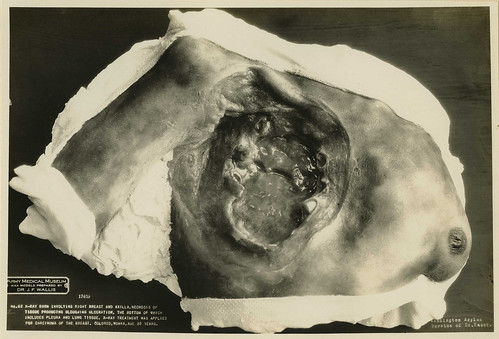
These are folks that are literally being killed by software glitches and operator error. This kind of behavior is one of the reasons I rail against privacy, especially the corporate privacy that shields the medical industry from public scrutiny. Without transparency, we can't find out who's being hurt, where the mistakes are made, who's making them, or why.
But you might think these errors are exceptions to the rule, and are quickly and transparently corrected. Nope.
In June, The Times reported that a Philadelphia hospital gave the wrong radiation dose to more than 90 patients with prostate cancer — and then kept quiet about it. In 2005, a Florida hospital disclosed that 77 brain cancer patients had received 50 percent more radiation than prescribed because one of the most powerful — and supposedly precise — linear accelerators had been programmed incorrectly for nearly a year.
So, the courts should take care of this, because the victims will be suing like crazy ... right?
“My suspicion is that maybe half of the accidents we don’t know about,” said Dr. Fred A. Mettler Jr., who has investigated radiation accidents around the world and has written books on medical radiation.
Identifying radiation injuries can be difficult. Organ damage and radiation-induced cancer might not surface for years or decades, while underdosing is difficult to detect because there is no injury. For these reasons, radiation mishaps seldom result in lawsuits, a barometer of potential problems within an industry.
The Times article lays out the details of several botched cases, with the eerie precision of a horror movie.
The lesson, then, is that patients have to be careful to choose responsible providers. Only, nobody knows the good guys from the bad guys:
Patients who wish to vet New York radiotherapy centers before selecting one cannot do so, because the state will not disclose where or how often medical mistakes occur.
To encourage hospitals to report medical mistakes, the State Legislature — with the support of the hospital industry — agreed in the 1980s to shield the identity of institutions making those mistakes. The law is so strict that even federal officials who regulate certain forms of radiotherapy cannot, under normal circumstances, have access to those names.
Even with this special protection, the strongest in the country, many radiation accidents go unreported in New York City and around the state. After The Times began asking about radiation accidents, the city’s Department of Health and Mental Hygiene reminded hospitals in July of their reporting obligation under the law. Studies of radiotherapy accidents, the city pointed out, “appear to be several orders of magnitude higher than what is being reported in New York City, indicating serious underreporting of these events.”
The Times collected summaries of radiation accidents that were reported to government regulators, along with some that were not. Those records show that inadequate staffing and training, failing to follow a good quality-assurance plan and software glitches have contributed to mistakes that affected patients of varying ages and ailments.
It keeps getting better. Apparently, the privacy of incompetent therapists is more important than preventing malpractice:
In 2008, at Stony Brook University Medical Center on Long Island, Barbara Valenza-Gorman, 63, received 10 times as much radiation as prescribed in one spot, and one-tenth of her prescribed dose in another. Ms. Valenza-Gorman was too sick to continue her chemotherapy and died of cancer several months later, a family member said. The therapist who made those mistakes was later reprimanded in another case for failing to document treatment properly.
The therapist not only continues to work at the hospital, but has also trained other workers, according to records and hospital employees. A spokeswoman for Stony Brook said privacy laws precluded her from discussing specifics about patient care or employees.
And, yeah, the regulators gathering this information are toothless:
Fines or license revocations are rarely used to enforce safety rules. Over the previous eight years, despite hundreds of mistakes, the state issued just three fines against radiotherapy centers, the largest of which was $8,000.
How do we tackle this? On the state level, or the federal level? What are the reporting laws in other states, like my home of California? Are there any good examples of agencies responsibly collecting this malpractice data?
[Thanks to otisarchives3 and Sandi for the pics.]
12 January 2010
Homeless Sex Offenders: Is there an app for that?
 Would you rather have paroled sex offenders live closer to you and your local schools and know where they live, or would you rather they be homeless, and more likely to re-offend? Is there a neighborhood-watch app that could help us out of this dilemma? (more after the jump)
07 January 2010
State and Energy: A Wonk's-Eye View
Ever since my Fellowships at the U.S. State Department and the Department of Energy, I've fielded calls from friends, acquaintances, and complete strangers, all looking for more information about my time there, how I got those gigs, and how those beasts actually function.
It's no wonder. The details available in places like Wikipedia on these bureaucracies are fairly sparse and abstract. (Which is surprising, since there are a few books on
on the subject
 , which I haven't read.) Where folks do talk openly about their time in such places, they might focus on juicy gossip about their co-workers, scandals, and major events, rather than on how the organizations actually operate—and how folks should use these systems to their advantage, from both within and without.
There are some pretty good reasons for much of this, as will hopefully become apparent. There are many incentives to keep information hidden, not all nefarious. Luckily, since I don't work at either place anymore, I can say (almost) whatever I please.
So, as an occasional series, I'll try to fill in some gaps. I'll start off with the State Department, as it's better-known and more fresh in my mind. If you have any questions to start off, please ask!
 |
It's no wonder. The details available in places like Wikipedia on these bureaucracies are fairly sparse and abstract. (Which is surprising, since there are a few books
on the subject, which I haven't read.) Where folks do talk openly about their time in such places, they might focus on juicy gossip about their co-workers, scandals, and major events, rather than on how the organizations actually operate—and how folks should use these systems to their advantage, from both within and without.There are some pretty good reasons for much of this, as will hopefully become apparent. There are many incentives to keep information hidden, not all nefarious. Luckily, since I don't work at either place anymore, I can say (almost) whatever I please.
So, as an occasional series, I'll try to fill in some gaps. I'll start off with the State Department, as it's better-known and more fresh in my mind. If you have any questions to start off, please ask!
01 January 2010
Transparency Now Banished.
I like to think I was into transparency before transparency was cool. Even Secretary Clinton trotted "transparency" out for the Copenhagen climate talks. Apparently, now it's passé:
Word "czars" at Lake Superior State University "unfriended" 15 words and phrases and declared them "shovel-ready" for inclusion on the university's 35th annual List of Words Banished from the Queen's English for Mis-use, Over-use and General Uselessness.
"The list this year is a 'teachable moment' conducted free of 'tweets,'" said a Word Banishment spokesman who was "chillaxin'" for the holidays. "'In these economic times', purging our language of 'toxic assets' is a 'stimulus' effort that's 'too big to fail.'"
Former LSSU Public Relations Director Bill Rabe and friends created "word banishment" in 1975 at a New Year's Eve party and released the first list on New Year's Day. Since then, LSSU has received tens of thousands of nominations for the list, which includes words and phrases from marketing, media, education, technology and more.
TRANSPARENT/TRANSPARENCY
"I can see clearly that this is the new buzzword for the year." -- Joann Eschenburg, Clinton Twp., Mich.
"In the lexicon of the political arena, this word is supposed to mean obvious or easily understood. In reality, political transparency is more invisible than obvious!" -- Deb Larson, Bellaire, Mich.
"I just don't see it." – Joe Grimm, Bloomfield Hills, Mich.This just makes it official. I've resigned myself to becoming part of the counterculture.
11 December 2009
Cheering for Open Hearings in San Jose
The Merc issued a smart editorial today demanding that arbitration hearings that affect taxpayer money should be opened to the public.
I cheered them on, with the below statement. Enjoy.
I cheered them on, with the below statement. Enjoy.
Access to the public is exactly appropriate for any arbitration hearing that affects the public's money. We should go further, however, and demand that all negotiations that affect public funds, such as those highlighted by Councilman Oliverio, should be recorded and made public after a suitable embargo period. This embargo would allow negotiators enough latitude to propose compromises, while remaining eventually accountable to their constituents–whether union members, shareholders, or voters. Even India, with some of the worst corruption in the world, has implemented their Right to Information act, putting similar information into the public domain after 30 days. Democracy only works when our right to know is respected. It is ridiculous that our access to information is worse than India's. Kohl S. Gill Sunnyvale
10 December 2009
Scientists Playing with FOIA, Bound to Get Burned: Stop Worrying, Embrace Transparency
Today's scientists are effectively public servants, and should start behaving accordingly. The public has a right to know what scientists do and how they do it. To prevent scandals like Climategate, scientific correspondence, critiques, and even data manipulation must be done in public. The University of East Anglia and associated climate scientists didn't understand that. I'm not sure they do, even now that their emails were hacked and used to sow doubt about climate science. Jon Stewart sums up the problem better than I can:
| The Daily Show With Jon Stewart | Mon - Thurs 11p / 10c | |||
| Scientists Hide Global Warming Data | ||||
| ||||
This isn't an excuse for climate change denialists. (Please don't call those folks "skeptics".) Climate change is real, it's caused by man, and there are reasonable steps we can take to halt and reverse the damage.
The hackers who extracted emails from UEA committed a crime. In so doing, they exposed that several scientists called people dismissive names, manipulated access to blogs, adjusted data in non-obvious ways, and derided their obligations under the law such as the U.S. and U.K. Freedom of Information Acts (FOIAs).
What bothered me most was the disregard for the law. The most damning example from the emails I've found includes this passage, from Phil Jones to Michael Mann (emphasis mine):
The passage goes on to other topics, but you get the picture.
What bothered me most was the disregard for the law. The most damning example from the emails I've found includes this passage, from Phil Jones to Michael Mann (emphasis mine):
Mike,
I presume congratulations are in order - so congrats etc !
Just sent loads of station data to Scott. Make sure he documents everything better this time ! And don't leave stuff lying around on ftp sites - you never know who is trawling them. The two MMs have been after the CRU station data for years. If they ever hear there is a Freedom of Information Act now in the UK, I think I'll delete the file rather than send to anyone. Does your similar act in the US force you to respond to enquiries within 20 days? - our does ! The UK works on precedents, so the first request will test it.
We also have a data protection act, which I will hide behind. Tom Wigley has sent me a worried email when he heard about it - thought people could ask him for his model code. He has retired officially from UEA so he can hide behind that. IPR should be relevant here, but I can see me getting into an argument with someone at UEA who'll say we must adhere to it !
The passage goes on to other topics, but you get the picture.
The reaction to this crime should not be bigger and thicker firewalls, or at least not solely that. Scientists should realize by now that privacy is not absolute, and in most cases, it's not even a good idea. They should embrace transparency, by moving correspondence to more open formats like blogs, wikis, and Google Wave. This move is critical to maintaining the long-term respect and public support for science. Obviously these platforms need to be adjusted to accommodate the complex manipulations of large data sets; the scientific community is in the best position to demand for and contribute to the development of appropriate applications. They will find great allies in the library science and open government communities, folks tackling the same essential problem. One great example is the Alliance for Taxpayer Access. In any case, scientists need to get out in front regarding transparency, or risk letting deniers define the route, themselves.
Some scientists may argue at this point, claiming that such presumptions of transparency will stifle free and open discussion and debate, that scientists working in the public sphere will censor themselves, and that the best ideas will not come forward. They might worry that science would become even more politicized than it already is. These might be fair points; after all, much of scientific inquiry is based on proposing and discarding ideas, ideas that seem crazy at first, but may just be right.
The answer is to embrace the embargo. Embargoes are already used throughout the scientific enterprise. Usually, they're used by scientific journals to delay access to non-paying readers, but they can be used in other ways, as well. Scientist A collects data and wants to analyze it and publish. While working on it, she shares her data with Scientist B so as not to delay further analysis. Oftentimes, as a courtesy or by agreement, Scientist B holds his own results under an embargo until Scientist A has had a chance to publish her results. This avoids confusion over which person should get credit for the initial data and analysis.
Wary scientists should know that everything they do, every email they write, every correction of data, every keystroke, could eventually wind up in the public domain. The platforms that will serve those scientists best will incorporate a time-bound embargo, with definite and obvious, rolling expiration dates.
As Judith Curry of Georgia Tech puts it (emphasis mine):
[G]iven the growing policy relevance of climate data, increasingly higher standards must be applied to the transparency and availability of climate data and metadata. These standards should be clarified, applied and enforced by the relevant national funding agencies and professional societies that publish scientific journals... The need for public credibility and transparency has dramatically increased in recent years as the policy relevance of climate research has increased. The climate research enterprise has not yet adapted to this need, and our institutions need to strategize to respond to this need.
This actually isn't a loss of privacy–which doesn't really exist, anyway–but rather a move to make science even more legitimate and accessible to the public. We should all recognize the great value the world has derived from access to earlier scientific correspondence. Occasionally, the public needs to be reminded that scientific inquiry is a human enterprise. Transparent scientists are ones they can believe in.
[P.S.: Judith Curry has done a fantastic job of corresponding with (initially hostile) commenters at the Climate Audit blog. Some of her top comments are here, here, here, here, here, here, here, here, here, here, here, here, here and here.]
[Edit: Added emphasis.]
[Edit: Added emphasis.]
08 December 2009
Yahoo Thinks You're Gay. Now, Find Out Why.
Ever wonder why you get the particular advertisements you see when using tools like Yahoo? Most of the time, the ads relate to the content you're accessing at the time, like ads for pet services when you spend all day looking at cute pictures of kittens instead of applying for jobs like you promised you would.
But even if you're not logged in at sites like Yahoo!, Google, or Facebook, those companies tend to collect quite a bit of information on you, creating their own consumer profile of you, which they use to match you up with targeted ads. Wouldn't it be great to take a look at that profile? Wouldn't you like the option to edit such a profile, or turn it off altogether?
 Thanks to increasing pressure from transparency advocates and the U.S. Federal Trade Commission, Yahoo! is taking a baby step in this direction. Yahoo! is launching a test version of it's Ad Interest Manager (AIM), which shows you a summary of the info that Yahoo! has on you. I haven't logged in at Yahoo! in a while, so without logging in, I took this screenshot of the AIM site. Now, it definitely gets some things right, like my age range, gender, OS and browser. It still thinks I'm in DC, which is odd because I'm on the other coast, now. When I log in, I see exactly the same profile, except that "Entertainment" has been added as an interest.
Note that Yahoo! appears to know who I am, even when I'm logged out! Yahoo's policy is to de-identify data after 6 months at the most, but they never delete it.
To be sure, this kind of access is only the beginning of what consumers should demand, and the AIM tool has received mixed reviews from confusing, but better than Google to half-hearted. But, it is a start.
Are there alternative search engines that will show you what data they collect?
[Google's closest analog - Dashboard]
[Edit: Grammar, and the last question.]
But even if you're not logged in at sites like Yahoo!, Google, or Facebook, those companies tend to collect quite a bit of information on you, creating their own consumer profile of you, which they use to match you up with targeted ads. Wouldn't it be great to take a look at that profile? Wouldn't you like the option to edit such a profile, or turn it off altogether?
 Thanks to increasing pressure from transparency advocates and the U.S. Federal Trade Commission, Yahoo! is taking a baby step in this direction. Yahoo! is launching a test version of it's Ad Interest Manager (AIM), which shows you a summary of the info that Yahoo! has on you. I haven't logged in at Yahoo! in a while, so without logging in, I took this screenshot of the AIM site. Now, it definitely gets some things right, like my age range, gender, OS and browser. It still thinks I'm in DC, which is odd because I'm on the other coast, now. When I log in, I see exactly the same profile, except that "Entertainment" has been added as an interest.
Note that Yahoo! appears to know who I am, even when I'm logged out! Yahoo's policy is to de-identify data after 6 months at the most, but they never delete it.
To be sure, this kind of access is only the beginning of what consumers should demand, and the AIM tool has received mixed reviews from confusing, but better than Google to half-hearted. But, it is a start.
Are there alternative search engines that will show you what data they collect?
[Google's closest analog - Dashboard]
[Edit: Grammar, and the last question.]
30 September 2009
Lies, Damn Lies, and Chinese Math: Over 1 Billion Snowed
Even the Chinese don't trust Chinese statistics, and they have the catchy phrases to prove it.
Apparently Science Magazine's Letters section is the only venue to pick up the Xinhua News Agency article on the new regulation issued by the Chinese National Bureau of Statistics, which clarifies the penalties and procedures for prosecuting statistical corruption.
The letter, by Junguo Liu and Hong Yang of Beijing Forestry University and Swiss Federal Institute of Aquatic Science and Technology, respectively, gives an intriguing insight into how the Chinese people view the corruption in their own statistics:
Apparently Science Magazine's Letters section is the only venue to pick up the Xinhua News Agency article on the new regulation issued by the Chinese National Bureau of Statistics, which clarifies the penalties and procedures for prosecuting statistical corruption.
The letter, by Junguo Liu and Hong Yang of Beijing Forestry University and Swiss Federal Institute of Aquatic Science and Technology, respectively, gives an intriguing insight into how the Chinese people view the corruption in their own statistics:
Statistical corruption has been found in China for years, largely for two reasons. First, economic growth is a key factor determining the promotion of government officials. Statistical data and numbers are regarded as a reflection of economic growth, which is used to evaluate the performance of the officials. This is the so-called "numbers make leaders" phenomenon ("shu zi chu guan" in Chinese). Second, the statistical organizations are not independent entities in China. They are a part of the government and hence are vulnerable to government interference. Without specific laws and regulations to punish statistical corruption, government leaders can intervene in statistical reporting with low political risks. They may tailor statistics for different purposes, such as inflating statistical numbers that indicate economic achievements and decreasing statistical numbers for environmental pollution and damage. This is the so-called "leaders make numbers" phenomenon ("guan chu shu zi" in Chinese).My guess is that the move by the NBS to curb official corruption is at least partly due to the recent scandal surrounding Qiu Xiaohua, former director of the National Bureau of Statistics, who was sacked and expelled from the Chinese Communist Party in 2007.
27 September 2009
Jefferson, Interrupted
 Thomas Jefferson's words are heavily censored in his own memorial in Washington, DC. Consider this passage from the Declaration of Independence, inscribed on the interior of the memorial:
We hold these truths to be self-evident that all men are created equal, that they are endowed by their Creator with certain inalienable rights, among these are life, liberty, and the pursuit of happiness, that to secure these rights governments are instituted among men. We...solemnly publish and declare, that these colonies are and of right ought to be free and independent states...And for the support of this declaration, with a firm reliance on the protection of divine providence, we mutually pledge our lives, our fortunes, and our sacred honour.
 Despite the fact that the passage in yellow was never written by Jefferson, this looks fair enough, until you take a look at the actual text of the Declaration:
We hold these truths to be self-evident, that all men are created equal, that they are endowed by their Creator with certain unalienable Rights, that among these are Life, Liberty and the pursuit of Happiness. That to secure these rights, Governments are instituted among Men, deriving their just powers from the consent of the governed, That whenever any Form of Government becomes destructive of these ends, it is the Right of the People to alter or to abolish it, and to institute new Government, laying its foundation on such principles and organizing its powers in such form, as to them shall seem most likely to effect their Safety and Happiness.The passage in green, which Jefferson thought was the whole point of the Declaration, was dropped. Some editing to conserve space is appropriate, but this gutting of his message is ridiculous. Of course, I'm not the first to notice this censorship. Let's hope I won't be the last.
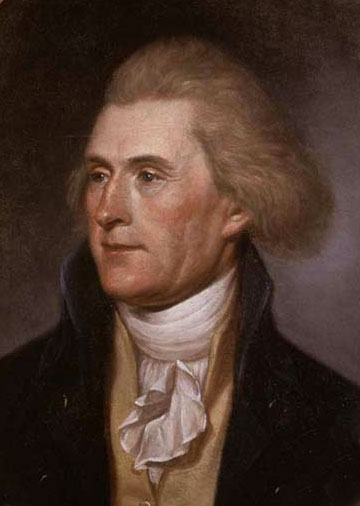
In light of Mr. Jefferson's prominent role as the supplier of our new lead quotation here, let's raise a glass to this Founding Father, censored in his own memory.
Update: Since folks have asked, my point is that this type of editing is dangerously Orwellian. Even our national monuments may be lying to us. (The memorial was constructed just a few years before Orwell completed 1984.)
(Thanks to Tony the Misfit for the gorgeous image of the Memorial.)
15 September 2009
What's Wrong with Privacy? (Transparency Matters #1)
 Over the past few years, I've become something of a transparency nut. One of the problems with transparency as movement is that very few people even recognize the term, much less know what it is. Once they see an example of transparency, they're often quite supportive.
I'm taking a different tack. I'm going to outline why privacy is bad for you. Bad for you, bad for your health, bad for your family, bad for your economy, bad for your politics, bad for your security, bad for your planet.
Or, at least I'm going to try.
Privacy as a social phenomenon is not terribly old. Indeed, the first taste that most Americans experienced was the privacy of isolation, and then of anonymity, which they got by moving to the American wilderness, and then to cities and suburbs.
Privacy as an activity is not terribly natural. Privacy isn't holy, or even well-defined as a philosophical or legal concept. The US Constitution doesn't explicitly lay out a right to privacy; the First, Fourth, Ninth, and Fourteeth Amendments are often stretched to serve as such. The courts don't recognize privacy except in those cases where citizens have a reasonable expectation of privacy.
Privacy is inconvenient. As we see in the social networking phenomenon and online advertising, folks are trading more information about themselves and their habits in exchange for better-tailored goods and services. Though most social networks, e.g., Facebook, have detailed privacy settings, most users leave these settings off for convenience.
"You have zero privacy anyway. Get over it." - Scott McNealy, Sun Microsystems, 1999
Privacy is illusory. Private detectives agree that the most effective way to get information about someone is not through cameras, microphones, wiretaps, or keystroke monitoring. Rather, it's much easier to find all you need to know by using Google, sifting through publicly accessible civil and divorce court records, criminal and driving records, credit histories, physical mail, digging into garbage, and chatting up that gossipy neighbor or brother-in-law.
Privacy is distracting. Privacy is used as a solution to more fundamental social concerns. You shouldn't have to keep your information private to prevent harassment, identity theft, or stalking. Those are already crimes, in and of themselves, and privacy is a flimsy barrier to them, at best.
Privacy is corrosive. Many social movements have their roots in liberating folks who do not fit the stereotype of normal, and bringing the falsity of those stereotypes out into daylight. A short list of relevant issues would include: domestic physical and sexual abuse (privacy of the family); homosexuality (privacy of sexual behavior); as well as alcoholism, drug abuse, dyslexia, AIDS (privacy of medical conditions). In each of these cases, the first step toward dealing with the issue was and is confronting the damage that privacy has done.
Privacy is contagious. Modern corporations and other firms have taken the idea of privacy into the business sphere and we continue to see the repercussions. Untraceable banking transactions are only one example of a practice that facilitates more than just the recent financial crisis. Consider drug-running, gun- and ammunition-smuggling, human trafficking, and terrorist criminal enterprises. If you could trace every dollar that changes hands, you would be a long way toward preventing and prosecuting crimes as well as protecting and providing restitution for victims. If you could open the books of every firm, financial crises like this could be avoided.
Privacy is expensive. Privacy is now a huge industry. Privacy is not insurance, which has the value of increasing your resilience in a measurable way. Rather, privacy purports to increase your protection, with few guarantees. You trade your information, often along with your money, to Company A for goods and services. Then you pay Company B to make sure that Company A doesn't release that same information. And only rarely do you get the opportunity to see the information that has been collected about you – to see how it is being used, for example – even to simply correct the information itself.
Privacy is wrong. You know that your government works for you, but you still see excessive secrecy in all the functions of government. Scandals involving abuse of power, corruption, waste and fraud abound as a direct result of privacy. This privacy has crept into government decision-making, awarding of contracts, evaluation of contractors and the operations of those contractors. You should be able to access any information involving the government or its functions without encumbrance or delay. The only legitimate delay is when the privacy involved is crucial to the security of the nation.
Privacy is insidious. You want to be paid well, and to be paid fairly, for what you do, but you're often told to keep your wages private. This privacy allows you to be paid unfairly, by allowing arbitrary decisions, such as those based on gender, race, age, or hairstyle, to affect your wage. Also, since everyone is quiet about wages, you never know the true value of your work, and are never able to bargain based on that value. This has the net effect of suppressing the wages of truly valuable workers. This stems from the idea that evaluations, especially of individuals, are more accurate if they are private. Private evaluations are a sign of ineffective management. And making them public can even be fun.
Privacy is inefficient. You have to waste time, and you even receive lower-quality of care, because of waste in the medical industry. This waste is due to privacy considerations around the sharing of your medical records, at least in part. This privacy is supported by an absurd system that requires you to keep secrets from your current and future insurance companies, at the risk of your own health. Worse yet, medicine itself suffers from this privacy because researchers cannot access your information, even to find out which medical procedures are most effective for people like you.
Privacy is not necessary. There is an alternative. You can choose differently.
You can choose to create a more transparent society. Imagine a society in which you can voluntarily release information, with the understanding that you can always see what is done with that information, how it's used, how it's changed, and what the benefits and detriments are. Imagine a society where your neighbors don't snoop on you, not because they can't, but just because it's rude and they have better things to do. Imagine a society where you can do good by working hard, paying your taxes, and serving your community with the assurance that you can see just how other people are doing those things, too. Imagine a society where your governments, businesses, and other organizations don't waste precious resources just because they can get away with it. It could be a society where we all dispense with financial privacy to strike a resounding blow against organized crime, world-wide.
At the very least, such a society could be quite interesting.
Is this a society worth striving for? If so, how do we get there from here?
14 September 2009
The Hiatus Ends
After over a year of silence, I'll be writing in this space again. (For some of the reasons I've been out, see: New Job, and Possible Radio Silence.)
I'm excited to resume writing about transparency, and I have lots and lots in the hopper to share. I'm also looking for paying work in the Bay Area as I move to Sunnyvale, CA, in October. The job search is tough, but it does allow me some time to devote to writing.
As you watch this space, you'll see several interweaving series of posts, on my last couple of jobs in the federal government, on my progress in finding the next great job, on why transparency matters, on great sources of information, and a whole lot more.
Let's get started.
09 September 2008
A New Dawn for India, and the World
Wow. I would really hate to be a corrupt bureaucrat in India right now. I have a feeling those guys are about to have their butts handed to them.
And it's about time.
Anti-corruption superhero and tireless transparency advocate Shailesh Gandhi was recently appointed to the Indian Central Information Commissioner. Though I have seen reports that he has been named as the Chief Information Commissioner, until I see the official notice, such news is simply too good to be true.
Here's Shailesh speaking in Portland, OR, USA:
When I heard this news, I nearly fell out of my chair crying with joy. Seriously. I spent way too long fighting corruption in India to take this with my usual cool distance. Luckily for the voters of DC, I was able to maintain my composure while working the polls.
This is a victory for the world, not just India. Right now, India is experimenting on the forefront of transparency legislation. Imagine, as a US citizen, being able to ask the government not only why your Social Security check is late, but who exactly in the bureaucracy is responsible, their names, their contact information, their service records. Now imagine extending that power to keep an eye on almost all parts of government. Imagine personal accountability for failed levees and squandered disaster relief. Amazing.
Of course, you don't just magically land in a position like this. There are reasons and they shouldn't be ignored. But still, this is awesome.
With power like this, now being enforced by the likes of Shailesh Gandhi, corrupt bureaucrats should be quaking in their boots.
Here's a video of the power of the Indian Right to Information Act:
Go Shailesh, Go!
And it's about time.
Anti-corruption superhero and tireless transparency advocate Shailesh Gandhi was recently appointed to the Indian Central Information Commissioner. Though I have seen reports that he has been named as the Chief Information Commissioner, until I see the official notice, such news is simply too good to be true.
Here's Shailesh speaking in Portland, OR, USA:
When I heard this news, I nearly fell out of my chair crying with joy. Seriously. I spent way too long fighting corruption in India to take this with my usual cool distance. Luckily for the voters of DC, I was able to maintain my composure while working the polls.
This is a victory for the world, not just India. Right now, India is experimenting on the forefront of transparency legislation. Imagine, as a US citizen, being able to ask the government not only why your Social Security check is late, but who exactly in the bureaucracy is responsible, their names, their contact information, their service records. Now imagine extending that power to keep an eye on almost all parts of government. Imagine personal accountability for failed levees and squandered disaster relief. Amazing.
Of course, you don't just magically land in a position like this. There are reasons and they shouldn't be ignored. But still, this is awesome.
With power like this, now being enforced by the likes of Shailesh Gandhi, corrupt bureaucrats should be quaking in their boots.
Here's a video of the power of the Indian Right to Information Act:
Go Shailesh, Go!
01 September 2008
Journalists Give Workers the Business

I couldn't really think of a better title than the original one of this report from the Center for American Progress. They did a quantitative review of major news outlets and show how workers are systematically ignored in favor of business sources, even on news issues that workers and unions know a lot about!
They found:
- Overall, representatives of business were quoted or cited nearly two-and-a-half times ƒ as frequently as were workers or their union representatives.
- In coverage of both the minimum wage and trade, the views of businesses were ƒ sourced more than one-and-a-half times as frequently as those of workers.
- In coverage about employment, businesses were quoted or cited over six times as frequently as were workers.
- On only one issue that we examined, ƒ credit card debt, was coverage more balanced, presenting the perspectives of ordinary citizens in the same pro- portion as those of business.
Here are some screenshots of their data for you to scroll through.


It's important to remember that business sources aren't necessarily any more expert on issues like the minimum wage, employment, and trade than labor sources. Academics were counted separately in this study.
I find it interesting to think about what our society would look like if we had 2.5 times more people in management than in labor.
From the article:
But the best explanation for the kind of bias described in this report is that journalists have a preference for elite sources, such as government or business representatives, over ordinary citizens. In short, it is just easier for a reporter to talk to a professional, such as a business spokesperson, than to find a good quote from a worker or ordinary citizen who does not represent a set interest group.
Of course, this doesn't explain everything, since journalists seemed to find plenty of citizen sources for their credit-card debt coverage.

31 August 2008
New Job, and Possible Radio Silence
I'm about to start a new job, and that may delay my future posts a bit.
For the past two years, I've been an AAAS Science Policy Fellow working at the US Department of Energy's Office of Science. More details on what I did there can be found here.
On 2 September 2008, I'll start my most intriguing position yet. Again I'll be a Science Policy Fellow, but this time I'll be working at the US Department of State's Office of International Labor and Corporate Social Responsibility (ILCSR). There, I'll have responsibility for coordinating US Government efforts in and with the countries of South Asia and maybe a bit more besides. Since I've gotten a lot of questions from folks, here are some FAQ's:
For the past two years, I've been an AAAS Science Policy Fellow working at the US Department of Energy's Office of Science. More details on what I did there can be found here.
On 2 September 2008, I'll start my most intriguing position yet. Again I'll be a Science Policy Fellow, but this time I'll be working at the US Department of State's Office of International Labor and Corporate Social Responsibility (ILCSR). There, I'll have responsibility for coordinating US Government efforts in and with the countries of South Asia and maybe a bit more besides. Since I've gotten a lot of questions from folks, here are some FAQ's:
Q: What's this about South Asia? Weren't you there before?
A: Yes, I was. In this job I'll be covering the Maldives, Sri Lanka, Bangladesh, Nepal, Bhutan, Pakistan and India. I may have some responsibility over Afghanistan and other countries of Central Asia, but it's really uncertain at the moment.
Q: What does the State Department have to do with labor rights?
A: In many of our agreements with other countries, trade treaties and otherwise, there are labor and human rights conditions. The basic idea is that we try not to import goods made with slave labor, forced labor, child labor, etc., so trade sanctions are the "stick". We also want to help countries improve their labor conditions, so we work with them to train labor advocates, government officials, and even executives in private companies on how to do that (the "carrot").
Q: Will you get to travel to the region? How often?
A: That's unclear, as yet. It's likely that I'll make at least one trip, and likely two. At the very least, I hope I get a trip long enough to get some personal time to visit my friends in Delhi and Ahmedabad, as well as to refresh my professional wardrobe. If there is a major relevant conference in the area, that might be a determining factor.
Q: They let someone like you do this job? What ever happened to standards?
A: A Secret-level Security Clearance is necessary for this job, as I'll have to look at diplomatic communications of a somewhat sensitive nature. I had to go through the process, which is an especially big pain for immigrants, even for the child of immigrants.
Q: What does the State Department have to do with labor rights?
A: In many of our agreements with other countries, trade treaties and otherwise, there are labor and human rights conditions. The basic idea is that we try not to import goods made with slave labor, forced labor, child labor, etc., so trade sanctions are the "stick". We also want to help countries improve their labor conditions, so we work with them to train labor advocates, government officials, and even executives in private companies on how to do that (the "carrot").
Q: Wait—Why do we care about labor rights in other countries, again?
A: I don't know about the US Government, but I care for a few reasons. First, supporting labor rights for all humans is one of my values, so I would prefer to advance those values when and where I can. Second, I care about US workers, and don't want them to have to compete with slave labor, because that's not fair. Third, isolated injustice breeds global violence, and we can't afford any more of that. Fourth, well-paid workers overseas make great markets for US goods, and that helps US workers, also.
Q: What part will you play in the State Department's work?
A: Right now, I'm not entirely sure. I know I'll play a role in coordinating labor programs in South Asia funded by the State Department, the US Department of Labor, and others. I'll also play a role in the writing of the annual Human Rights Report—the highest-profile document that the State Department puts out.
Q: What would you like to do in this position?
A: I have a few ideas:
Q: What part will you play in the State Department's work?
A: Right now, I'm not entirely sure. I know I'll play a role in coordinating labor programs in South Asia funded by the State Department, the US Department of Labor, and others. I'll also play a role in the writing of the annual Human Rights Report—the highest-profile document that the State Department puts out.
Q: What would you like to do in this position?
A: I have a few ideas:
- I'd like to put my science training to work, and raise the profile of the scientific components of labor issues. These include the environmental, safety and health effects associated with labor. You can think of the recycling of e-waste into heavy metals that end up contaminating our imported toys and jewelry, as one example.
- I'd also like to look at the way technology can assist in monitoring labor standards. From the statistics of forensic accounting to GIS mapping techniques, the possibilities for multiplying the force of labor rights monitors are tremendous. I could imagine such technology helping to detect, deter and disrupt anything from child soldiering to sex trafficking to ... well, you name it!
- I'd like to use my previous transparency and anti-corruption experience to push for better governance and accountability mechanisms. For example, unions can be effective as advocates for their members only when they are open, democratic, and accountable to those members.
- Similarly, I think there's lots of room in the region for supply-chain transparency and accountability. This is where the corporate social responsibility comes in. Even well-meaning US multinationals have a hard time making sure that their overseas partners are living up to global standards. Independent and rigorous evaluation bodies are desperately needed to coordinate between the businesses as well as labor and government players.
Q: Will you get to travel to the region? How often?
A: That's unclear, as yet. It's likely that I'll make at least one trip, and likely two. At the very least, I hope I get a trip long enough to get some personal time to visit my friends in Delhi and Ahmedabad, as well as to refresh my professional wardrobe. If there is a major relevant conference in the area, that might be a determining factor.
Q: They let someone like you do this job? What ever happened to standards?
A: A Secret-level Security Clearance is necessary for this job, as I'll have to look at diplomatic communications of a somewhat sensitive nature. I had to go through the process, which is an especially big pain for immigrants, even for the child of immigrants.
Q: How long before they are able to correct this obvious hiring error?
A: I'm planning for this temporary position to last at least a year. Beyond that, it's up to AAAS and my bosses at State to decide whether they want me to stay. Here's hoping I do well!
Q: What will you do after this position? Why did you take (yet another!) temporary position? Aren't you tired of being a "Fellow"?
A: I've been aiming my career toward traditional science policy for a while, and have gotten a decent taste of it over the last few years. It's exhilarating. But my interests are much broader than that, and have leaned heavily in the human rights realm. This position offers a great opportunity to bridge the worlds of science and human rights, much as I was earlier attempting to bridge the academic and government worlds. Besides, like many folks in DC, I'm not planning on being here for too much longer.
Q: So what's this about delayed posts?
A: Well, I don't want it to appear that this space is speaking on behalf of the US Government. That puts all of my publications in an interesting spot. I'll try to keep writing with caveats before and after each post, and hopefully that will be enough. If not, I may have to delay future entries until after this position has ended.
Subscribe to:
Posts (Atom)

A More Transparent Union by Kohl S. Gill is licensed under a Creative Commons Attribution-Noncommercial-Share Alike 3.0 United States License.
Based on a work at kohlgill.blogspot.com.

 Posts
Posts


