Pages

Showing posts with label privacy. Show all posts

29 January 2010

Real-Life Bruce Banners, Uncounted (Transparency Matters, #2)

The worst part about folks being crippled and dying from medical radiation accidents is that no one is keeping track of how many there are.  This isn't just gradual radiation poisoning; in one case, a linear accelerator accidentally burned a hole in a woman's chest.

“I just had a big hole in my chest,” she would say. “You could just see my ribs in there.”


Details of these cases, says the Times, "have until now been shielded from public view by government, doctors and [hospitals]."  It gets better:

The Times found that while this new technology allows doctors to more accurately attack tumors and reduce certain mistakes, its complexity has created new avenues for error — through software flaws, faulty programming, poor safety procedures or inadequate staffing and training. When those errors occur, they can be crippling...
Regulators and researchers can only guess how often radiotherapy accidents occur. With no single agency overseeing medical radiation, there is no central clearinghouse of cases. Accidents are chronically underreported, records show, and some states do not require that they be reported at all.
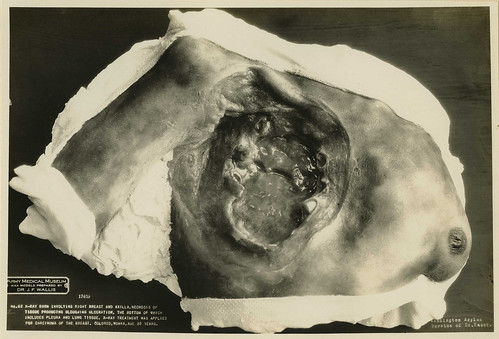
These are folks that are literally being killed by software glitches and operator error.  This kind of behavior is one of the reasons I rail against privacy, especially the corporate privacy that shields the medical industry from public scrutiny.  Without transparency, we can't find out who's being hurt, where the mistakes are made, who's making them, or why.

But you might think these errors are exceptions to the rule, and are quickly and transparently corrected.  Nope.

In June, The Times reported that a Philadelphia hospital gave the wrong radiation dose to more than 90 patients with prostate cancer — and then kept quiet about it. In 2005, a Florida hospital disclosed that 77 brain cancer patients had received 50 percent more radiation than prescribed because one of the most powerful — and supposedly precise — linear accelerators had been programmed incorrectly for nearly a year.

So, the courts should take care of this, because the victims will be suing like crazy ... right?


“My suspicion is that maybe half of the accidents we don’t know about,” said Dr. Fred A. Mettler Jr., who has investigated radiation accidents around the world and has written books on medical radiation.

Identifying radiation injuries can be difficult. Organ damage and radiation-induced cancer might not surface for years or decades, while underdosing is difficult to detect because there is no injury. For these reasons, radiation mishaps seldom result in lawsuits, a barometer of potential problems within an industry.

The Times article lays out the details of several botched cases, with the eerie precision of a horror movie.

The lesson, then, is that patients have to be careful to choose responsible providers.  Only, nobody knows the good guys from the bad guys:


Patients who wish to vet New York radiotherapy centers before selecting one cannot do so, because the state will not disclose where or how often medical mistakes occur.

To encourage hospitals to report medical mistakes, the State Legislature — with the support of the hospital industry — agreed in the 1980s to shield the identity of institutions making those mistakes. The law is so strict that even federal officials who regulate certain forms of radiotherapy cannot, under normal circumstances, have access to those names.

Even with this special protection, the strongest in the country, many radiation accidents go unreported in New York City and around the state. After The Times began asking about radiation accidents, the city’s Department of Health and Mental Hygiene reminded hospitals in July of their reporting obligation under the law. Studies of radiotherapy accidents, the city pointed out, “appear to be several orders of magnitude higher than what is being reported in New York City, indicating serious underreporting of these events.”

The Times collected summaries of radiation accidents that were reported to government regulators, along with some that were not. Those records show that inadequate staffing and training, failing to follow a good quality-assurance plan and software glitches have contributed to mistakes that affected patients of varying ages and ailments.

It keeps getting better.  Apparently, the privacy of incompetent therapists is more important than preventing malpractice:


In 2008, at Stony Brook University Medical Center on Long Island, Barbara Valenza-Gorman, 63, received 10 times as much radiation as prescribed in one spot, and one-tenth of her prescribed dose in another. Ms. Valenza-Gorman was too sick to continue her chemotherapy and died of cancer several months later, a family member said. The therapist who made those mistakes was later reprimanded in another case for failing to document treatment properly.

The therapist not only continues to work at the hospital, but has also trained other workers, according to records and hospital employees. A spokeswoman for Stony Brook said privacy laws precluded her from discussing specifics about patient care or employees.


And, yeah, the regulators gathering this information are toothless:

Fines or license revocations are rarely used to enforce safety rules. Over the previous eight years, despite hundreds of mistakes, the state issued just three fines against radiotherapy centers, the largest of which was $8,000.

How do we tackle this?  On the state level, or the federal level?  What are the reporting laws in other states, like my home of California?  Are there any good examples of agencies responsibly collecting this malpractice data?

[Thanks to otisarchives3 and Sandi for the pics.]

12 January 2010

Homeless Sex Offenders: Is there an app for that?

Sex Offenders: Identification, Risk Assessment, Treatment, and Legal IssuesWould you rather have paroled sex offenders live closer to you and your local schools and know where they live, or would you rather they be homeless, and more likely to re-offend?  Is there a neighborhood-watch app that could help us out of this dilemma? (more after the jump)

08 December 2009

Yahoo Thinks You're Gay. Now, Find Out Why.

Ever wonder why you get the particular advertisements you see when using tools like Yahoo?  Most of the time, the ads relate to the content you're accessing at the time, like ads for pet services when you spend all day looking at cute pictures of kittens instead of applying for jobs like you promised you would.

But even if you're not logged in at sites like Yahoo!, Google, or Facebook, those companies tend to collect quite a bit of information on you, creating their own consumer profile of you, which they use to match you up with targeted ads.  Wouldn't it be great to take a look at that profile?  Wouldn't you like the option to edit such a profile, or turn it off altogether?

Thanks to increasing pressure from transparency advocates and the U.S. Federal Trade Commission, Yahoo! is taking a baby step in this direction.  Yahoo! is launching a test version of it's Ad Interest Manager (AIM), which shows you a summary of the info that Yahoo! has on you.  I haven't logged in at Yahoo! in a while, so without logging in, I took this screenshot of the AIM site.  Now, it definitely gets some things right, like my age range, gender, OS and browser.  It still thinks I'm in DC, which is odd because I'm on the other coast, now.  When I log in, I see exactly the same profile, except that "Entertainment" has been added as an interest.

Note that Yahoo! appears to know who I am, even when I'm logged out!  Yahoo's policy is to de-identify data after 6 months at the most, but they never delete it.

To be sure, this kind of access is only the beginning of what consumers should demand, and the AIM tool has received mixed reviews from confusing, but better than Google to half-hearted.  But, it is a start.

Are there alternative search engines that will show you what data they collect?

[Google's closest analog - Dashboard]

[Edit: Grammar, and the last question.]

15 September 2009

What's Wrong with Privacy? (Transparency Matters #1)

Over the past few years, I've become something of a transparency nut. One of the problems with transparency as movement is that very few people even recognize the term, much less know what it is. Once they see an example of transparency, they're often quite supportive.

I'm taking a different tack. I'm going to outline why privacy is bad for you. Bad for you, bad for your health, bad for your family, bad for your economy, bad for your politics, bad for your security, bad for your planet.

Or, at least I'm going to try.

Privacy as a social phenomenon is not terribly old. Indeed, the first taste that most Americans experienced was the privacy of isolation, and then of anonymity, which they got by moving to the American wilderness, and then to cities and suburbs.

Privacy as an activity is not terribly natural. Privacy isn't holy, or even well-defined as a philosophical or legal concept. The US Constitution doesn't explicitly lay out a right to privacy; the First, Fourth, Ninth, and Fourteeth Amendments are often stretched to serve as such. The courts don't recognize privacy except in those cases where citizens have a reasonable expectation of privacy.

Privacy is inconvenient. As we see in the social networking phenomenon and online advertising, folks are trading more information about themselves and their habits in exchange for better-tailored goods and services. Though most social networks, e.g., Facebook, have detailed privacy settings, most users leave these settings off for convenience.

"You have zero privacy anyway. Get over it." - Scott McNealy, Sun Microsystems, 1999

Privacy is illusory. Private detectives agree that the most effective way to get information about someone is not through cameras, microphones, wiretaps, or keystroke monitoring. Rather, it's much easier to find all you need to know by using Google, sifting through publicly accessible civil and divorce court records, criminal and driving records, credit histories, physical mail, digging into garbage, and chatting up that gossipy neighbor or brother-in-law.

Privacy is distracting. Privacy is used as a solution to more fundamental social concerns. You shouldn't have to keep your information private to prevent harassment, identity theft, or stalking. Those are already crimes, in and of themselves, and privacy is a flimsy barrier to them, at best.

Privacy is corrosive. Many social movements have their roots in liberating folks who do not fit the stereotype of normal, and bringing the falsity of those stereotypes out into daylight. A short list of relevant issues would include: domestic physical and sexual abuse (privacy of the family); homosexuality (privacy of sexual behavior); as well as alcoholism, drug abuse, dyslexia, AIDS (privacy of medical conditions). In each of these cases, the first step toward dealing with the issue was and is confronting the damage that privacy has done.

Privacy is contagious. Modern corporations and other firms have taken the idea of privacy into the business sphere and we continue to see the repercussions. Untraceable banking transactions are only one example of a practice that facilitates more than just the recent financial crisis. Consider drug-running, gun- and ammunition-smuggling, human trafficking, and terrorist criminal enterprises. If you could trace every dollar that changes hands, you would be a long way toward preventing and prosecuting crimes as well as protecting and providing restitution for victims. If you could open the books of every firm, financial crises like this could be avoided.

Privacy is expensive. Privacy is now a huge industry. Privacy is not insurance, which has the value of increasing your resilience in a measurable way. Rather, privacy purports to increase your protection, with few guarantees. You trade your information, often along with your money, to Company A for goods and services. Then you pay Company B to make sure that Company A doesn't release that same information. And only rarely do you get the opportunity to see the information that has been collected about you – to see how it is being used, for example – even to simply correct the information itself.

Privacy is wrong. You know that your government works for you, but you still see excessive secrecy in all the functions of government. Scandals involving abuse of power, corruption, waste and fraud abound as a direct result of privacy. This privacy has crept into government decision-making, awarding of contracts, evaluation of contractors and the operations of those contractors. You should be able to access any information involving the government or its functions without encumbrance or delay. The only legitimate delay is when the privacy involved is crucial to the security of the nation.

Privacy is insidious. You want to be paid well, and to be paid fairly, for what you do, but you're often told to keep your wages private. This privacy allows you to be paid unfairly, by allowing arbitrary decisions, such as those based on gender, race, age, or hairstyle, to affect your wage. Also, since everyone is quiet about wages, you never know the true value of your work, and are never able to bargain based on that value. This has the net effect of suppressing the wages of truly valuable workers. This stems from the idea that evaluations, especially of individuals, are more accurate if they are private. Private evaluations are a sign of ineffective management. And making them public can even be fun.

Privacy is inefficient. You have to waste time, and you even receive lower-quality of care, because of waste in the medical industry. This waste is due to privacy considerations around the sharing of your medical records, at least in part. This privacy is supported by an absurd system that requires you to keep secrets from your current and future insurance companies, at the risk of your own health. Worse yet, medicine itself suffers from this privacy because researchers cannot access your information, even to find out which medical procedures are most effective for people like you.

Privacy is not necessary. There is an alternative. You can choose differently.

You can choose to create a more transparent society. Imagine a society in which you can voluntarily release information, with the understanding that you can always see what is done with that information, how it's used, how it's changed, and what the benefits and detriments are. Imagine a society where your neighbors don't snoop on you, not because they can't, but just because it's rude and they have better things to do. Imagine a society where you can do good by working hard, paying your taxes, and serving your community with the assurance that you can see just how other people are doing those things, too. Imagine a society where your governments, businesses, and other organizations don't waste precious resources just because they can get away with it. It could be a society where we all dispense with financial privacy to strike a resounding blow against organized crime, world-wide.

At the very least, such a society could be quite interesting.

Is this a society worth striving for? If so, how do we get there from here?

25 August 2008

Censorship vs Terrorism? Animals vs Science?

The cars of two UCSC scientists and their families were firebombed earlier this month, reportedly by an animal-rights group. In response to these detestable attacks, some scientists have proposed internet censorship as a method of preventing this violent harassment. More than simply ineffective, this measure would be counterproductive. There is another, more transparent way that we should pursue immediately.

To be clear, no group has claimed responsibility for the attacks, and the animal-rights community is divided over the issue. The Humane Society has gone so far as to offer a reward for information about the perpetrators of the incident.

In their editorial in Science Magazine, M. R. C. Greenwood, Gordon Ringold, and Doug Kellogg (GRK) correctly characterize the situation while lamenting the lack of public outcry:
These are criminal acts, being investigated as an attempted homicide by local, state, and federal authorities. It is of serious concern that these acts of terrorism and their associated incendiary statements were not immediately condemned by our political leaders. There have been no high-profile or unified statements about the incidents, and days afterward, California's governor had still declined to comment.
GRK further identify the need to address underlying issues in this conflict:
Those responsible must be prosecuted to the full extent of the law. Those who oppose animal research, even when conducted under strict federal and state laws, are free to express those beliefs. They are also free to reject the medicines--the fruits of animal research--that now allow us to treat disease and lead healthier lives. But they are not free to conduct a terror campaign.
Though, most animal-rights activists would probably counter that they don't have an alternative; that is, they don't have the ability to reject products that have resulted from animal-testing because there's no rigorous tracking and labeling in place to identify viable alternatives. (Instead, the Center for Consumer Freedom, an industry-sponsored organization, fights all efforts to make products transparent, including nutritional labeling.)

But the proposed legislation, promoting secrecy as a solution, is where GRK really stumble:
State laws that reinforce these protections need to be enacted. A proposed bill in the California Legislature (AB2296), which would extend protection to "animal enterprise workers" similar to that provided for politicians and reproductive health workers, has been much weakened from its original intent. In its original form, it would have prevented the posting of personal information on Web sites with the intent to incite acts of violence or threaten researchers and their families.
This approach of locking down information to prevent violent harassment is wrongheaded and counterproductive. Data leaks do happen. If these lists are going to exist anyway, we are much better off having them in the open. That way, at least we know who's being targeted.

Here's what we should do:
  • As a society, we should prosecute these terrorists as criminals, and treat these actions as what they are, organized crime. That means bringing sophisticated financial tracking systems to bear, and applying relevant statutes like RICO to break down the support network for the groups that exist now. Financial transparency of all organizations is a way to prevent such groups from forming in the future.

  • As a scientific community, we should isolate these extremists by working closely with animal rights groups like the Humane Society and individuals like Stephen Kaufman of the Christian Vegetarian Association and Eric Markus of Vegan.com that have denounced violence as a means of progress. Along with pharmaceutical and cosmetic manufacturers, we should create clear tracking and labeling protocols to give citizens real information on how much and what kind of testing goes into each product on the market. This market transparency allows us all to see the real benefits of animal testing research, as well as the opportunity to reject those benefits.

  • Above all, we should not lean on censorship and secrecy for protection against violent harassment! Secrecy is a short-term solution at best, and is inherently unstable. Instead, as individual scientists, we should humanize ourselves to the animal rights community by engaging vigorously with those non-violent groups, to show them, first-hand, the science being done and the results generated.
Both scientists and activists agree that both human and animal suffering should be minimized. Let us use that as an opportunity for more transparency on all sides.