“I just had a big hole in my chest,” she would say. “You could just see my ribs in there.”

Details of these cases, says the Times, "have until now been shielded from public view by government, doctors and [hospitals]." It gets better:
The Times found that while this new technology allows doctors to more accurately attack tumors and reduce certain mistakes, its complexity has created new avenues for error — through software flaws, faulty programming, poor safety procedures or inadequate staffing and training. When those errors occur, they can be crippling...
Regulators and researchers can only guess how often radiotherapy accidents occur. With no single agency overseeing medical radiation, there is no central clearinghouse of cases. Accidents are chronically underreported, records show, and some states do not require that they be reported at all.
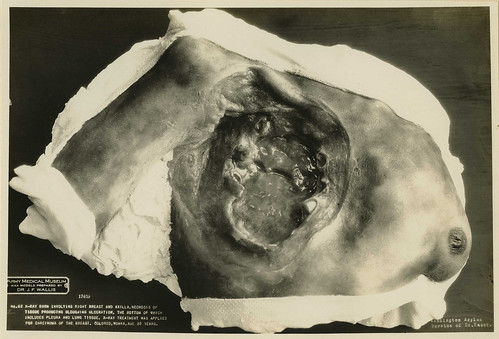
These are folks that are literally being killed by software glitches and operator error. This kind of behavior is one of the reasons I rail against privacy, especially the corporate privacy that shields the medical industry from public scrutiny. Without transparency, we can't find out who's being hurt, where the mistakes are made, who's making them, or why.
But you might think these errors are exceptions to the rule, and are quickly and transparently corrected. Nope.
In June, The Times reported that a Philadelphia hospital gave the wrong radiation dose to more than 90 patients with prostate cancer — and then kept quiet about it. In 2005, a Florida hospital disclosed that 77 brain cancer patients had received 50 percent more radiation than prescribed because one of the most powerful — and supposedly precise — linear accelerators had been programmed incorrectly for nearly a year.
So, the courts should take care of this, because the victims will be suing like crazy ... right?
“My suspicion is that maybe half of the accidents we don’t know about,” said Dr. Fred A. Mettler Jr., who has investigated radiation accidents around the world and has written books on medical radiation.
Identifying radiation injuries can be difficult. Organ damage and radiation-induced cancer might not surface for years or decades, while underdosing is difficult to detect because there is no injury. For these reasons, radiation mishaps seldom result in lawsuits, a barometer of potential problems within an industry.
The Times article lays out the details of several botched cases, with the eerie precision of a horror movie.
The lesson, then, is that patients have to be careful to choose responsible providers. Only, nobody knows the good guys from the bad guys:
Patients who wish to vet New York radiotherapy centers before selecting one cannot do so, because the state will not disclose where or how often medical mistakes occur.
To encourage hospitals to report medical mistakes, the State Legislature — with the support of the hospital industry — agreed in the 1980s to shield the identity of institutions making those mistakes. The law is so strict that even federal officials who regulate certain forms of radiotherapy cannot, under normal circumstances, have access to those names.
Even with this special protection, the strongest in the country, many radiation accidents go unreported in New York City and around the state. After The Times began asking about radiation accidents, the city’s Department of Health and Mental Hygiene reminded hospitals in July of their reporting obligation under the law. Studies of radiotherapy accidents, the city pointed out, “appear to be several orders of magnitude higher than what is being reported in New York City, indicating serious underreporting of these events.”
The Times collected summaries of radiation accidents that were reported to government regulators, along with some that were not. Those records show that inadequate staffing and training, failing to follow a good quality-assurance plan and software glitches have contributed to mistakes that affected patients of varying ages and ailments.
It keeps getting better. Apparently, the privacy of incompetent therapists is more important than preventing malpractice:
In 2008, at Stony Brook University Medical Center on Long Island, Barbara Valenza-Gorman, 63, received 10 times as much radiation as prescribed in one spot, and one-tenth of her prescribed dose in another. Ms. Valenza-Gorman was too sick to continue her chemotherapy and died of cancer several months later, a family member said. The therapist who made those mistakes was later reprimanded in another case for failing to document treatment properly.
The therapist not only continues to work at the hospital, but has also trained other workers, according to records and hospital employees. A spokeswoman for Stony Brook said privacy laws precluded her from discussing specifics about patient care or employees.
And, yeah, the regulators gathering this information are toothless:
Fines or license revocations are rarely used to enforce safety rules. Over the previous eight years, despite hundreds of mistakes, the state issued just three fines against radiotherapy centers, the largest of which was $8,000.
How do we tackle this? On the state level, or the federal level? What are the reporting laws in other states, like my home of California? Are there any good examples of agencies responsibly collecting this malpractice data?
[Thanks to otisarchives3 and Sandi for the pics.]


 Posts
Posts


